


 New Code Sent!

Commercial-style range features and styles
A commercial-style range borrows the look and high-heat performance of a professional restaurant kitchen, but it's engineered to work with a typical home's layout and utility hookups. Use this guide to dive into the features worth considering before you buy, from burner output and fuel type to width and ventilation.

What makes a range commercial-style?
A commercial-style range borrows high-BTU burners, heavy-duty grates and large front knobs from a professional kitchen, but unlike a true commercial range, it's built to be compatible with most typical residential kitchen designs and hookups.
If you like the professional look and want a commercial range for home use, a commercial-style model is generally a practical choice, since it’s sized and configured for everyday household cooking rather than restaurant-level volume.
Shop KitchenAid® Commercial-Style Ranges to get an idea of current models and offerings on the market.

Burner count and BTU output
Commercial-style ranges are often wider, and commonly offer additional cooktop burners with outputs ranging from around 5,000 BTUs on the smallest simmer burner up to roughly 20,000 BTUs on the largest burner. That spread lets a single range handle everything from melting chocolate to flash-searing a steak simultaneously.
A high-BTU burner is useful for fast boiling and searing, but the burner you reach for should always match the job, so a cooktop with a variety of BTU offerings can add ease to cooking. Because BTU output varies by make and model, it’s worth checking the spec sheet for the specific range you're considering.
Here's a general breakdown of typical commercial burner types and the output range each one covers:
| Burner type | Typical BTU range | Best for |
|---|---|---|
| Simmer burner | 500-5,000 BTUs | Melting, gentle simmering |
| All-purpose burner | 8,000-12,000 BTUs | Everyday cooking, sautéing and frying |
| Power burner | 12,000-20,000 BTUs | Searing, stir-frying, rapid boiling |
| Oval burner | ~10,000 BTUs | Griddles, oblong cookware |
| Dual ring burner | ~17,000 BTUs | Multipurpose: Simmering with one ring, boiling with both |
*The BTU range is a rough estimate. BTUs and available burners vary by make and model.
Learn more about gas stove burner types to discover how each burner performs during real cooking tasks.

Built-in griddles and cooktop layouts
Some commercial-style ranges include a built-in griddle, a flat, recessed cooking surface next to the burners that's designed for browning, searing and crisping food edge-to-edge. A griddle lets you explore recipes from pancakes to smashburgers with ease.
Because a griddle takes up the space of a burner or two, it’s worth thinking about how often you’d actually use one before choosing it over additional burner capacity.
For tips on getting the most out of a griddle, learn how to use one on a gas stove.

Gas, dual fuel or induction?
A gas range offers an open flame for charring and near-instant temperature changes; a dual fuel range pairs that same gas cooktop with an electric oven, offering the advantages of both in a single appliance, and an induction range uses electromagnetism to heat compatible cookware on the rangetop and electric heat in the oven.
If you’re weighing a dual fuel vs. gas range, it often comes down to your oven habits: A dual fuel model’s electric oven tends to distribute heat evenly for baking, while an all-gas oven may show more temperature variation as its flame cycles on and off. On top of oven use considerations, you’ll need to confirm your kitchen’s existing connections to see if they can support the model you want. Dual fuel and gas ranges both require a dedicated gas line, and typically require an outlet with 240 volts rather than the standard 120 volts.
A quick side-by-side can help clarify what each fuel type does best:
| Fuel type | Cooktop heat | Oven heat | Good for |
|---|---|---|---|
| Gas | Open flame, instant adjustment | Gas heat, may vary slightly | Searing, sautéing or charring on the cooktop |
| Dual fuel | Open flame, instant adjustment | Electric, consistent | Cooks who bake often but want a responsive gas cooktop |
| Induction | Electromagnetic, fast and precise | Electric, consistent | Fast heating, easy cooktop cleanup and consistent electric oven heat |
Learn more about dual fuel ranges to see how they stack up against gas and electric options.

Oven features: Convection, air fry and capacity
Many commercial-style ranges add true convection cooking, which pairs a heating element with a fan to circulate hot air so food on multiple racks bakes more evenly. Some commercial-style ranges, like this KitchenAid® model, also include No Preheat Air Fry Mode to bring versatility to your kitchen.
Because commercial-style ranges tend to run wider than a standard 30-inch model, they often have room for a larger single oven or even a second oven cavity, which can help if you regularly cook multiple dishes at once. Look for the oven’s capacity in cubic feet on the spec sheet if fitting a large holiday bird or two sheet pans side-by-side is important to you.
Oven features that may be worth considering include:
- True convection: A heating element and fan pair that circulate hot air for even baking and roasting across multiple racks.
- No-preheat air fry: Lets you air fry directly without waiting for the oven to reach temperature.
- Double oven: Two separate cavities so you can bake and roast at different temperatures at once.
- Oven capacity: Measured in cubic feet; wider ranges generally offer more usable space.
Learn more about different types of ovens if you’re comparing convection against other oven styles.
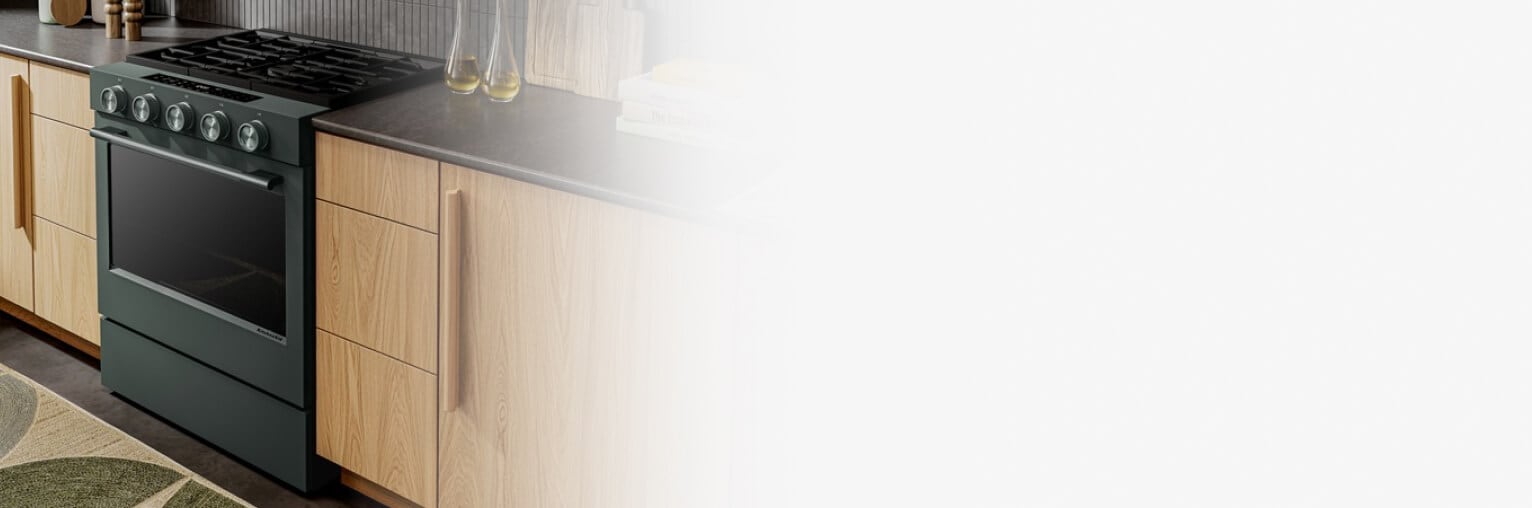
KitchenAid® ranges
A range for every kitchen
Explore slide-in and freestanding ranges crafted for performance and style to help you create your favorite recipes
30, 36 or 48 inches: Choosing a width
Commercial-style ranges often come in 30-, 36- and 48-inch widths. The wider the range, the more burners or griddle space and oven capacity it tends to offer.
Because these ranges typically install into a cabinet cutout of the same width, it’s worth measuring your available space and confirming clearances before committing to the largest model—a 48-inch range needs considerably more counter and cabinet room than a 30-inch model.
Here's a general sense of how the standard widths compare:
| Width | Typical burners* | Best for |
|---|---|---|
| 30 inch | 4-5 burners | Standard cutouts, daily use |
| 36 inch | 5-6 burners, may include a griddle | Frequent entertaining, larger households |
| 48 inch | 6+ burners, griddle, often double oven | Serious home cooks, big multi-dish meals |
*Some models may vary
Explore the commercial-style ranges buying guide for more on choosing the right size for your needs. Discover features like the Integrated Wok Grate, available on select KitchenAid® models, which lets you experience high-heat wok cooking with authentic stir-fry flavor right at home, or Two 20,000 BTU Dual-Flame Burners that give you precise control of powerful highs, steady lows and the wide range of temperatures in between.
Shop 36-inch commercial-style ranges from KitchenAid brand

Styles and finishes: Knobs, handles and color
Pro style ranges are often available in designs with large front control knobs and heavy-duty grates that echo a professional kitchen's look. You may also find bold and striking colors that can make your commercial-style range the focal point of your kitchen. For instance, you can find KitchenAid® Commercial-Style Ranges in colors like Wildflower, Agave, Cardamom, Scorched Orange and more.
Some models also let you personalize hardware separately from the range itself, swapping handles and knobs to match cabinet pulls or other appliances in the kitchen. Hardware Accessory Kits from KitchenAid brand are designed to coordinate with kitchen faucets and cabinet pulls so you can mix and match with confidence.

Venting a commercial-style range
Because commercial-style ranges may run hotter and are also often wider than standard models, they typically need a range hood that matches the cooktop’s width and is rated at or above the combined BTU output of all the burners below.
It isn’t always necessary to pair a commercial-style range with a commercial-style hood, but sufficient venting power is important, especially if you do a lot of searing, frying or sautéing, since those techniques tend to generate more smoke, steam and grease than everyday cooking. Check your specific model’s installation guide for exact clearance and duct requirements before installation.
Learn more about different types of range hoods to compare hood styles and coverage.


FAQs
Investing in a commercial-style range is no small decision, and every bit of information helps. Explore quick answers to common questions about commercial-style ranges, from hookups and sizing to everyday performance.
True commercial ranges aren’t meant for home use, but residential commercial-style ranges are. These models are designed to work with standard household gas and electrical connections while delivering many of the aesthetics and features of a true commercial range.
A commercial range is a true restaurant-grade appliance built for high-volume use, while a residential range—including commercial-style models—is sized for a home kitchen and typically includes four to six burners with a single oven (sometimes double in the case of a commercial-style model).
Not necessarily. A higher-BTU burner produces more heat and a bigger flame, which helps with fast boiling and searing, but a lower-BTU burner is often better suited to a gentle simmer for dishes like a delicate sauce. Most cooks are best served by a mix of high- and low-output burners rather than having only high-BTU burners.
The main trade-offs are a longer electric oven preheat time compared with an all-gas range, plus the need for a dedicated gas line if your kitchen doesn’t already have one.
It depends on your kitchen and cooking habits. A 48-inch range needs considerably more space than a 30-inch model, so it tends to suit larger kitchens and cooks who regularly prepare big, multi-dish meals rather than everyday cooking for one or two people.
Yes. Some gas cooktops and ranges include a built-in griddle heated by its own burner, and on models without a dedicated griddle, a removable griddle attachment can sometimes be laid across the cooktop surface for more cooking flexibility.
Compared with a standard range, a pro-style range generally offers various options which may include higher-output burners, built-in griddles, larger ovens and heavy-duty knobs, along with durable, commercial-inspired materials.


Your subscription was successful
Thank you for signing up. Keep an eye on your inbox for our next newsletter.
Stay Connected – Join the List
Enjoy articles like this? Get helpful guides and appliance care tips sent straight to your inbox.
Was this article helpful? Pass it on
Explore more with KitchenAid brand
This article includes AI-generated content that our human team has reviewed and edited to ensure quality.

