









 New Code Sent!

Undercounter ice maker dimensions guide
The right undercounter ice maker for you needs to suit your space, your setup and how you’ll use it day to day. Accommodating this model may mean making tweaks to your existing layout. Use this guide to walk through typical dimensions, learn how to measure your space and discover undercounter ice maker features to find a seamless, built-in fit.


What are the standard undercounter ice maker dimensions?
Finding an ice maker that fits your space will likely be the first step when narrowing down your options. Undercounter ice maker sizes can vary by model, but generally, you can expect standard dimensions to fall within the following general ranges, though some models do vary:
Height: 35 inches
Width: 15-18 inches
- Depth: 23-24 inches
- Capacity: 25-30+ lbs.
Undercounter ice maker dimensions vs. cutout dimensions
An ice maker’s listed dimensions describe the appliance itself, while cutout dimensions refer to the opening you’ll need for installation. The opening is often slightly larger to allow for proper airflow, leveling and the electrical and waterline connections your ice maker needs.
On some models, adjustable leveling legs can change the final height of the ice maker, while hinges may require side clearance and the door or handle may extend beyond the cabinet face. Planning for these details before installation can help avoid a fit that’s too tight or limited.


How to measure for an undercounter ice maker
Whether you’re replacing an existing unit or installing one for the first time, use the steps below to guide you in measuring your cabinet opening and surrounding space for a smooth installation.
1. Measure the cabinet opening
Measure the width, height and depth of your cabinet opening. Measuring in multiple spots, from side to side and front to back, can help you catch uneven cabinetry or flooring. If your measurements aren’t consistent, always use the smallest one to ensure the appliance will fit.
You’ll need a cabinet opening that’s at least one inch larger than the ice maker’s width and depth, but no larger than an inch greater in height (as this may impact the built-in look undercounter ice makers offer).
2. Check your utility space
Plan for water line routing, possible drain access and space for the power cord. These connections may sit behind or beside the unit, depending on the model, so leaving a bit of clearance helps prevent pinching or crowding during installation.
3. Measure for door swing and ventilation
Allow enough clearance for the door to open fully without hitting nearby cabinets or walls, which may mean not installing it perfectly flush. Make sure nothing sits in front of your ice maker that may prevent proper ventilation.
4. Confirm your measurements
Double-check height, width and depth measurements, then take a step back and look at the big picture. Notice any nearby walls, islands or appliance handles that could block access to opening the door fully. Also account for any flooring transitions or uneven surfaces that may affect how the unit slides in or sits.
Shop KitchenAid® undercounter ice makers
Whether you’re hosting a large group or prepping your cooler for a night out, KitchenAid® undercounter ice makers make it easy to keep up with demand. Select KitchenAid® models feature Clear Ice Technology, which delivers ice cubes with uniform size and shape. Or, choose a KitchenAid® undercounter ice maker designed to be personalized with a curated palette of mixed metal hardware. You can personalize your hardware with optional handle accessory kits in Brass, Bronze, Black Ore and Stainless Steel.


Undercounter ice maker dimension FAQs
An undercounter ice maker can mean the end of running out of ice when you need it most. Read on to learn more about undercounter ice maker dimensions and installation.
What size undercounter ice maker should I buy?
The right size ice maker depends on your available space, where you plan to install the unit and how much ice you typically use. A compact 15-inch model may be well suited to a small kitchen or bar, while higher-capacity models may work well if you can spare a bit more space and often deal with high ice demand.
Undercounter ice makers typically produce and hold about 25-30 lbs of ice. You may find some models, like this KitchenAid® 18-inch undercounter ice maker, that can store up to 35 lbs of ice at a time.
Are undercounter ice maker dimensions the same for indoor and outdoor models?
You may find that outdoor and indoor ice makers feature similar dimensions, but it’s best to reference individual product specs to be certain. The primary difference between indoor and outdoor models is that outdoor models are often designed with more weather-resistant materials, which may or may not impact product dimensions.
Can an undercounter ice maker fit in the same opening as a dishwasher?
Generally, no. There would be too much space. Standard dishwashers are typically 24 inches wide, while standard undercounter ice makers range from about 15-18 inches wide. Even if widths align, you may find that plumbing, electrical and ventilation needs can differ.
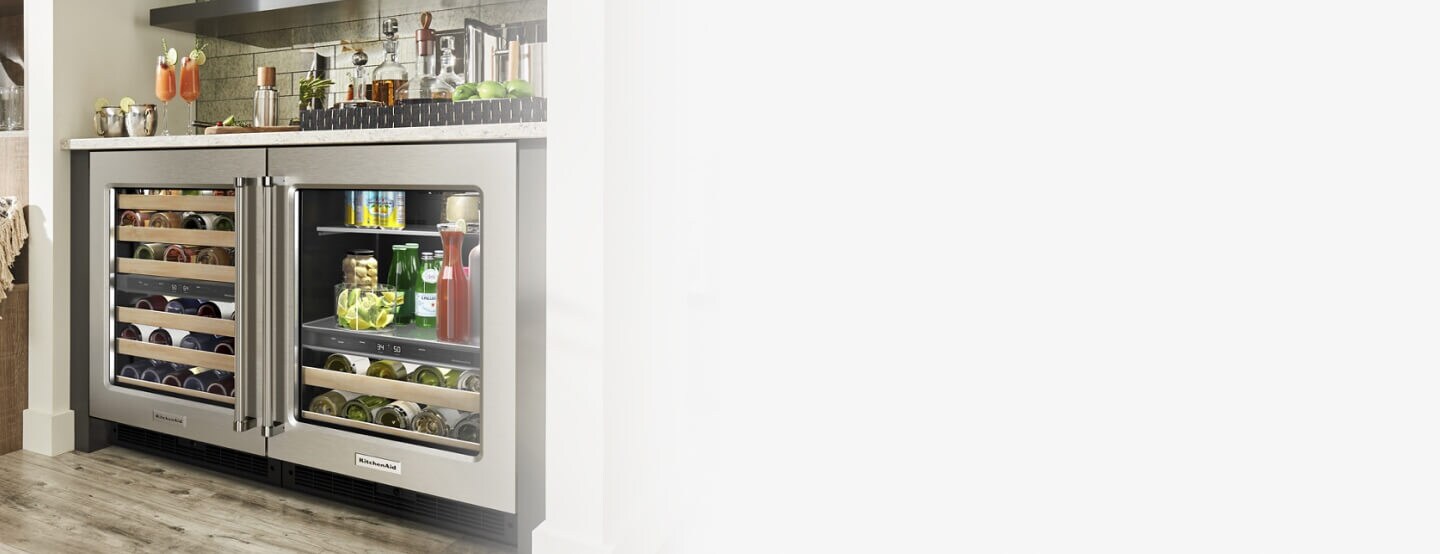
KITCHENAID® UNDERCOUNTER REFRIGERATORS
Designed for entertaining
KitchenAid® undercounter refrigerators offer extra food and beverage storage where you entertain so you can host in style with ease
Can any ice maker fit under a counter?
You may be able to fit a freestanding ice maker in a cabinet cutout beneath the countertop, but it likely won’t resemble the seamless, near-flush look of an undercounter model. Whether you opt for a freestanding or undercounter model, check that your ice maker has the space required for ventilation and utility hookups noted in the owner’s manual.
Do undercounter ice makers need a dedicated electrical outlet?
Undercounter ice makers typically require a properly grounded, 115 volt, 60 Hz, AC only, 15- or 20-amp electrical supply to perform at their best. Check your user manual to be sure, as models may vary. Without the right amount of electrical voltage, you may notice that your ice maker struggles to cool or produces low-quality ice.
Shop KitchenAid® undercounter refrigerators
Make more of your space with an undercounter refrigerator from KitchenAid brand. Select KitchenAid® models feature a Temperature Monitoring System that uses sensors to monitor temperatures inside the refrigerator for added peace of mind. For added flexibility, opt for a KitchenAid® Double-Drawer Refrigerator/Freezer featuring an Automatic Ice Maker that provides a continuous supply of filtered, crescent-shaped ice for all your party needs.


Your subscription was successful
Thank you for signing up. Keep an eye on your inbox for our next newsletter.
Stay Connected – Join the List
Enjoy articles like this? Get helpful guides and appliance care tips sent straight to your inbox.

