









 New Code Sent!

Kitchen range buying guide: Types and features
Whether you are a seasoned chef or a weekend baker, choosing the right range for your kitchen is one of the most important decisions you’ll make for your culinary space. This guide provides tools to help you make an informed investment by comparing gas, electric and induction fuel types, and evaluating the differences between freestanding and slide-in designs. It also explores key features—such as convection and smart technology—to help determine which model best aligns with your culinary goals and kitchen layout.
Whether you are fine-tuning your homemade bread recipe or simmering your traditional Bolognese sauce, your range is likely one of the most utilized appliances in your kitchen. Evaluate the various features of kitchen ranges in this guide to choose the best model for you.


What is a kitchen range?
A kitchen range is a two-in-one combination of an oven and a cooktop. It is typically installed in between kitchen cabinets but can also be freestanding. The oven portion of the range is often used for tasks like baking, roasting and broiling, while the cooktop provides heating elements for stovetop cooking tasks like sautéing, searing and boiling.
While these terms are often used interchangeably in modern homes, there are specific differences in terminology:
Range: An all-in-one cooking solution that combines a cooktop and an oven into a single, space-efficient appliance.
Stove: Historically, stoves were used to heat homes by burning wood or coal. Today, most people use the term "stove" to mean a modern kitchen range, as both terms now describe an appliance used exclusively for preparing food.
- Oven: An oven refers specifically to the enclosed, heated chamber used for cooking food. While an oven is one component of a range, it can also be a separate appliance entirely, such as a wall oven.
Compare range vs. stove vs. ovens to learn which appliance is right for your kitchen.


What should I look for when buying a kitchen range?
When purchasing a kitchen range, there are several key factors to consider such as size, venting (overhead vs. downdraft options), capacity, features, burner configuration and style. Continue reading to learn more about what to look for when purchasing a new range for your kitchen.
1. Size
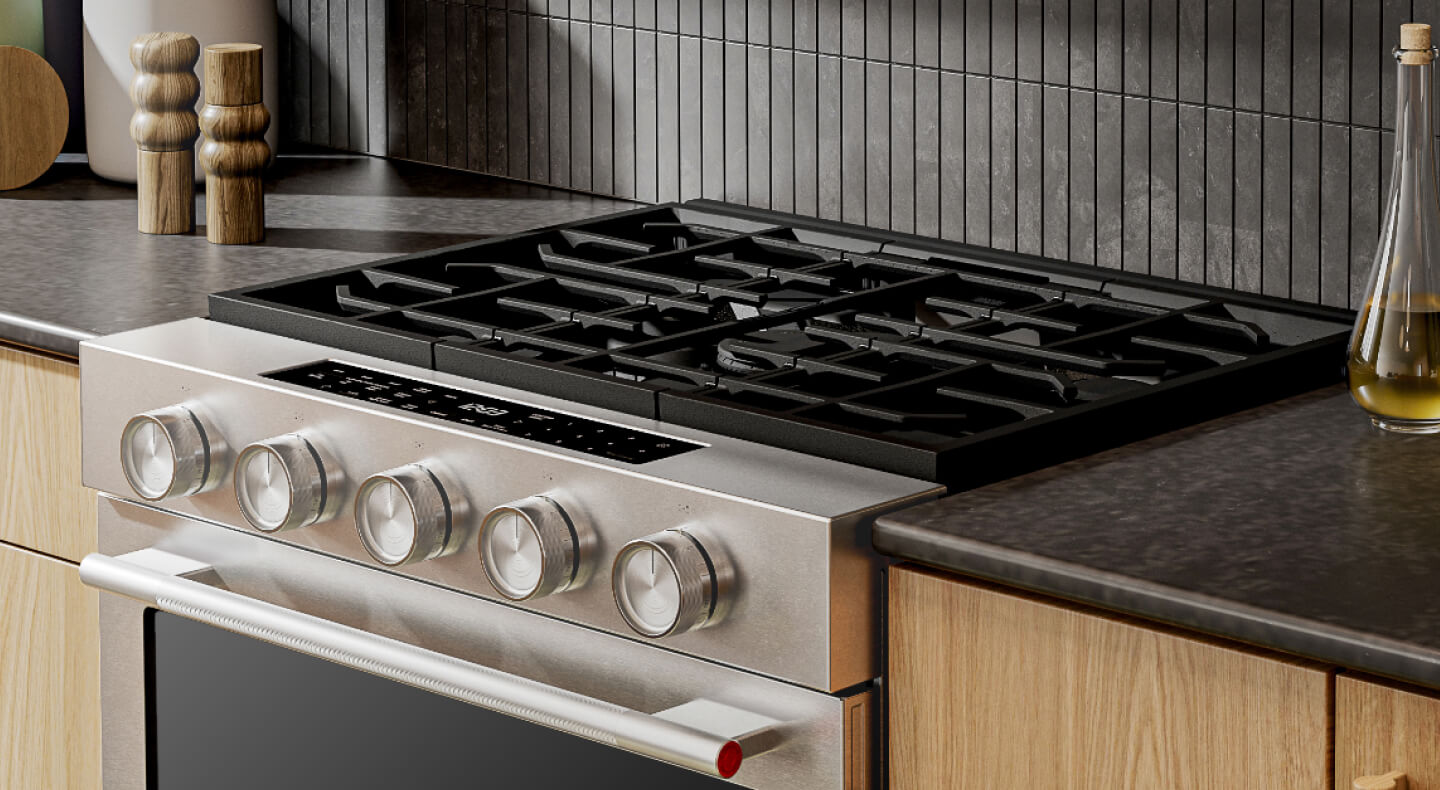
Choose a range that complements the size of your kitchen and meets your cooking needs, whether you experiment with stovetop techniques or enjoy baking for a crowd. Consider the amount of space you have available and how many burners or ovens you will need.
When selecting a range size, it is essential to consider clearance requirements for installation and ensure you measure your existing cutout before shopping for a proper fit. The following measurements are estimates and some models do vary.
Widths: Typically 20-24 inches for compact, 30-36 inches for standard and 48-60 inches for extra-wide models.
Depths: Usually measure between 25-27 inches.
Heights: Around 36-41 inches, with some compact models making up for width with height.
- Burners: The number of burners often varies between 4 to 6, depending on the model.

2. Capacity
You should also consider the capacity of a range in your decision. Look for models that offer ample space for cooking multiple dishes at once and feature large oven capacities if you plan on preparing multi-course meals or hosting large events. You may even consider double ovens for added convenience and versatility in cooking.
Understanding oven capacity can help provide the creative freedom you need in your kitchen, as it directly relates to your cooking flexibility. A larger capacity allows you to prepare items that require substantial vertical or horizontal room—such as tall layer cakes, standing rib roasts or multiple full-size baking sheets stacked across different racks. When evaluating capacity, consider the rack count and whether the oven dimensions can accommodate multiple standard baking sheets.
Freestanding ranges from KitchenAid brand come in capacities from about 5.8 to 6.2 cu. ft., while slide-in models are available in capacities up to around 6.4 cu. ft.

3. Burners
When shopping for a range, look for models that offer the number and type of burners you need. Ranges typically come with 4 to 6 burners, depending on the size of the range. In addition to burner number, a variety of burner sizes can help accommodate large and small pots and pans.
Some ranges also have specialized burners with preset heat settings that allow you to easily go from a rolling boil to a gentle simmer. Interlocking grates are another convenient feature found on select gas ranges that provide a level cooking surface so you can easily change burners and move pots and pans across the entire range.
KitchenAid® ranges offer a variety of burner heat levels, sizes and shapes to help you discover new cooking techniques and reinvent old favorites. Cook with the heat you need from 5,000 to 17,000 BTU gas burners so you can go from a rolling boil to a delicate simmer. Or take your creations up a notch with two 20,000 BTU Ultra Power™ Dual-Flame Burners on select KitchenAid® commercial-style models. Look for features such as an integrated griddle or wok option for additional versatility, or smooth, easy to clean electric models.

4. Style
Style is a vital consideration when buying a range, as it defines the visual center of your kitchen. To create a modern look and feel with your KitchenAid® range, choose from various finishes—including black stainless steel, Juniper and Black Ore—or opt for classic stainless steel. Depending on your cabinetry layout, you may want to consider slide-in models for a built-in look, or freestanding models with an integrated backguard.
For those seeking a professional aesthetic at home, the KitchenAid brand lineup of commercial-style ranges offers an expanded palette of bold colors. Beyond standard finishes, select dual-fuel models are available in vibrant hues like Agave, Wildflower, Scorched Orange and Cardamom. These models often feature industrial-style touchpoints, such as large knobs and prominent grates, providing a high-end, functional design.
To further ensure your appliance aligns with your vision, select KitchenAid® ranges are designed to be personalized with Hardware Accessory Kits. These kits allow you to customize the handles and knobs of select ranges with premium finishes, including:
Brass: Lends a bright accent for a modern look.
Stainless Steel: Brings commercial-style design to your home.
Bronze: Adds subtle warmth for a timeless look.
- Black Ore: Provides a bold contrast for a contemporary look.

5. Features
Modern ranges come with many features that can help you elevate your cooking, try new techniques and get inspired. Consider models with convenient digital controls, warming drawers, convection capabilities, or self-cleaning options that allow you to focus on your next creation.
Select KitchenAid® ranges include features such as Rapid Boil, No Preheat Air Fry Mode, and Aqualift®, which combines low heat with water to release baked-on spills.
Other KitchenAid® ranges also feature Smart Appliance technology that lets you control the oven with your Google Assistant or an Alexa-enabled device to stay hands-on or hands-off.1 The KitchenAid™ App lets you conveniently preheat, proof, bake and roast, plus store your favorite recipes for easy reference.
1. Wi-Fi & App required. Features subject to change. Amazon Alexa capabilities available in U.S. only. Google Assistant capabilities available globally. For details and privacy info, visit KitchenAid.com/Connect (U.S.) or KitchenAid.ca/Connect (Canada). Alexa, Google and certain other trademarks are owned by their respective companies.

6. Downdraft
Downdraft ranges and cooktops have an integrated ventilation system that draws fumes, smoke and steam across the cooktop and into the vent. Air is then either vented outside or filtered and recirculated back into the kitchen, depending on the downdraft model.
You may want to consider a downdraft range or cooktop to help clear the air and provide a convenient venting solution. This is helpful if you can’t install an overhead range hood or your cooktop is part of a kitchen island with an open concept that you don't want to disrupt with overhead ventilation.


Types of ranges
Ranges come in a few different types that all have benefits, depending on your cooking style and your kitchen. Range options include freestanding, slide-in, commercial and double oven. Learn more about each type of range below, so you can decide which suits your cooking and your kitchen’s aesthetic best.

1. Freestanding ranges
Freestanding ranges are not built into the countertop or cabinets and they often have a built-in backguard where oven controls and displays are located. Freestanding ranges come in gas, electric and dual fuel models and typically have finished sides, allowing for flexibility in their kitchen placement.
If your range will stand alone or you anticipate changing your kitchen layout over the lifetime of the range, a freestanding model can provide extra flexibility. While the price of stoves varies widely based on features, materials, size and other considerations, freestanding ranges tend to offer a lower entry price point.
2. Slide-in ranges
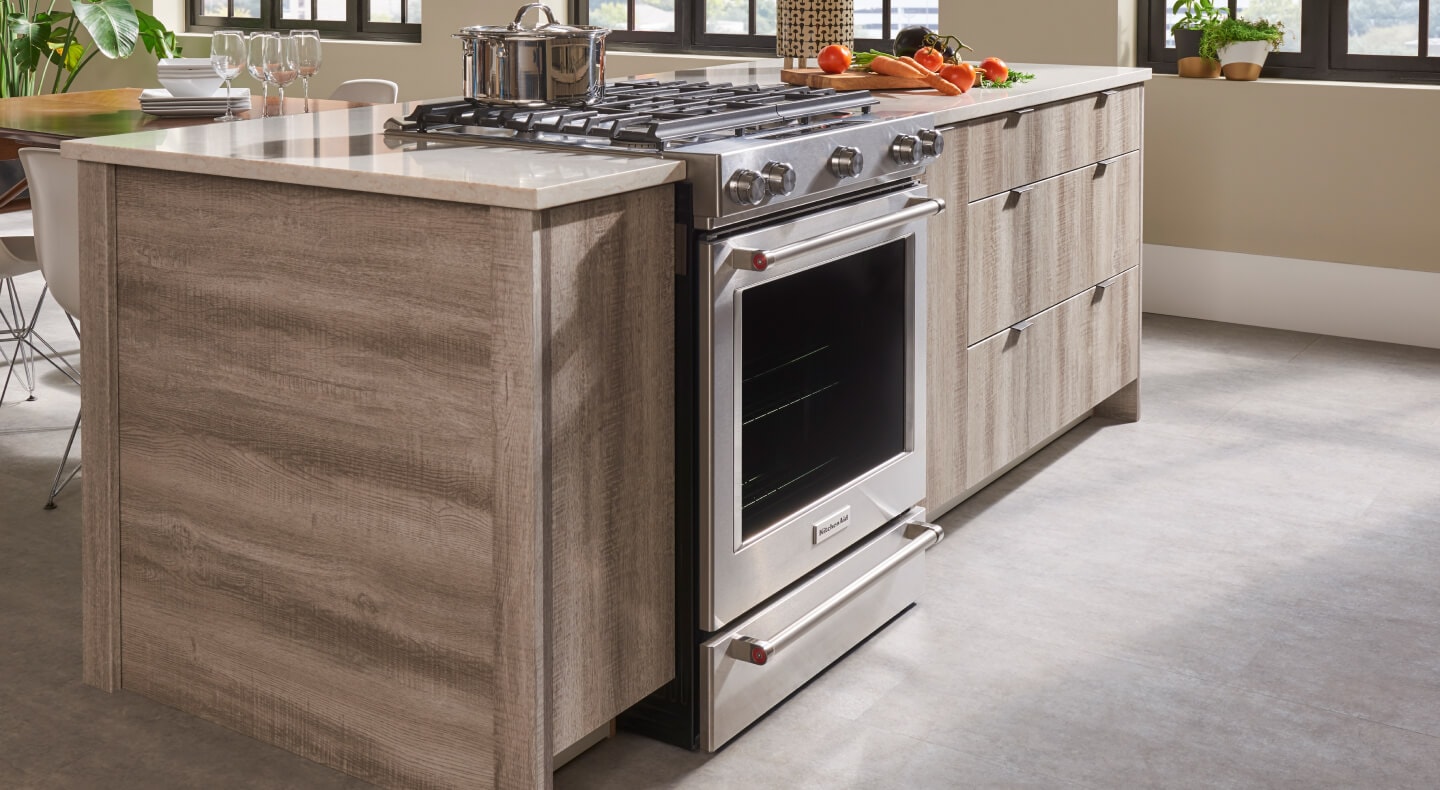
Slide-in ranges are designed for installation between cabinets or in kitchen islands and allow for an open layout. They do not have a built-in backguard like freestanding ranges. On a slide-in range, all controls are usually at the front of the appliance which gives the range a built-in look. This also allows for a decorative backsplash or the installation of a pot-filler behind your range.
Some brands feature products with the FIT System to help ensure your new appliance will fit your available space. For instance, KitchenAid brand offers some slide-in ranges with the FIT System Limited Guarantee to seamlessly fit your new slide-in model into an existing cutout of 30" width, countertop depth of 24"-25", cabinet depth of 23"-24", and countertop height of 36".
This configuration offers several advantages, such as a seamless, built-in appearance and overhanging sides on select models that can help keep food and liquids from spilling into gaps between the cooktop and the counter. Because the controls are prominently displayed on the front, they are a practical choice for kitchen islands where a rear backguard would obstruct the view. However, there are installation considerations to keep in mind.
Slide-in ranges have unfinished sides, which prevent them from being installed as stand-alone appliances. Additionally, rather than going up against a wall, they are often installed with a few inches of countertop space that wraps around the back of the cooktop. If you are replacing a freestanding model, you may need to ensure the wall behind the range can withstand steam, water and stains, as slide-in models lack a protective backguard.

3. Commercial-style ranges
Designed with the home gourmet in mind, commercial ranges offer similar features and styling to commercial ranges in restaurants, with sizes and designs that fit your space. Commercial ranges are available from 30"-48" and in gas, electric and dual fuel configurations. These ranges often come with a variety of burner configurations and include griddles and other specialty cooking surfaces. Compare commercial-style vs. standard ranges to find the right fit for your kitchen.
Equipped with features such as Even-Heat™ True Convection and Two High-Heat Dual Flame Burners, select KitchenAid® commercial-style ranges can help you bring restaurant-quality results to your kitchen. Select KitchenAid® commercial-style ranges also include an Integrated Wok Grate, No Preheat Air Fry Mode and Three 15,000 BTU Burners.
To ensure your kitchen reflects your personal taste, some of these KitchenAid® ranges are designed to be personalized with a wide array of color and hardware options. Select commercial-style models from KitchenAid brand are available in sophisticated finishes like Stainless Steel, Juniper and Black Ore. For those seeking a bolder statement, select dual fuel models offer additional colors such as Agave, Wildflower, Scorched Orange and Cardamom. You can further customize select KitchenAid® ranges with optional Hardware Accessory Kits available in Brass, Stainless Steel, Bronze and Black Ore, allowing you to tailor the knobs and handles to your specific aesthetic.
4. Double oven
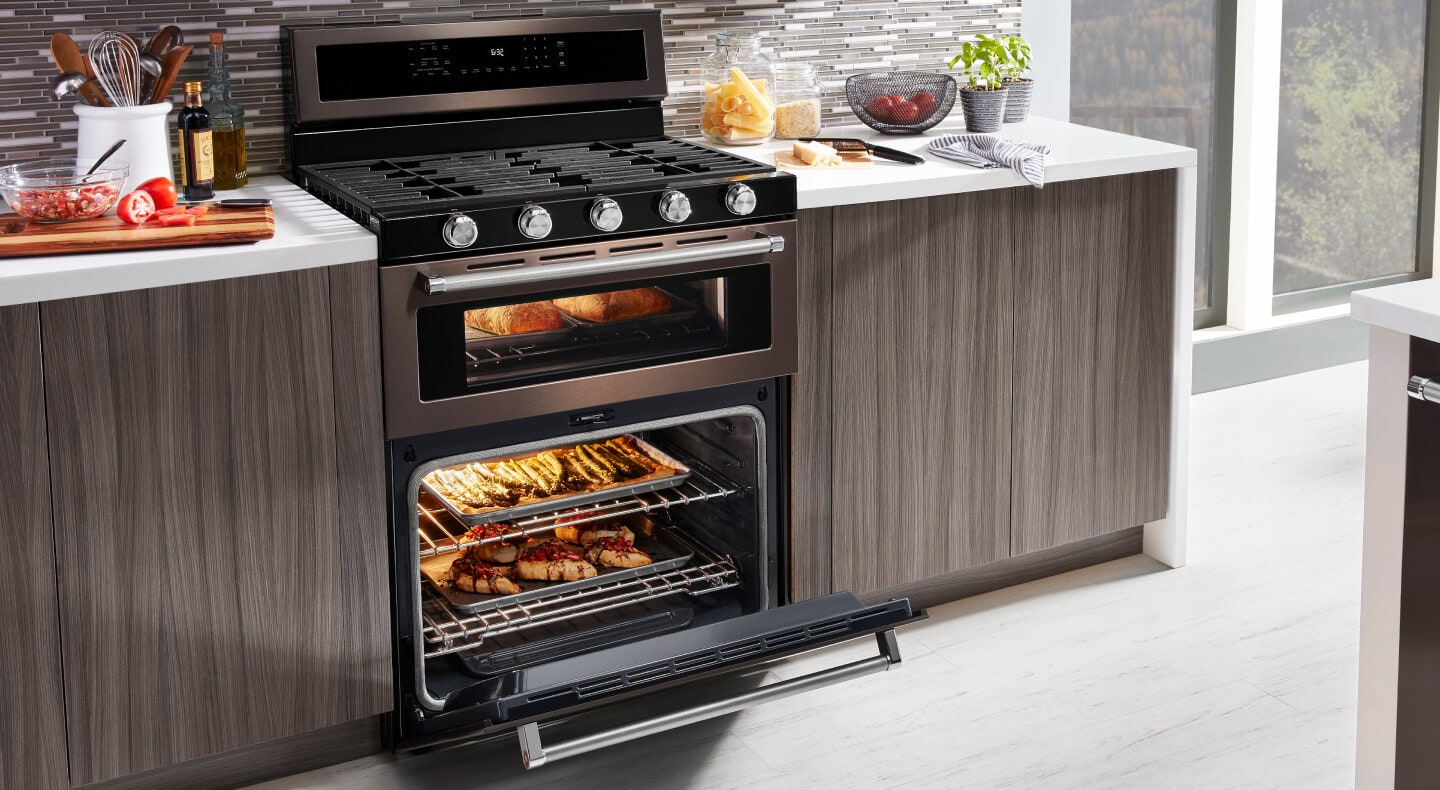
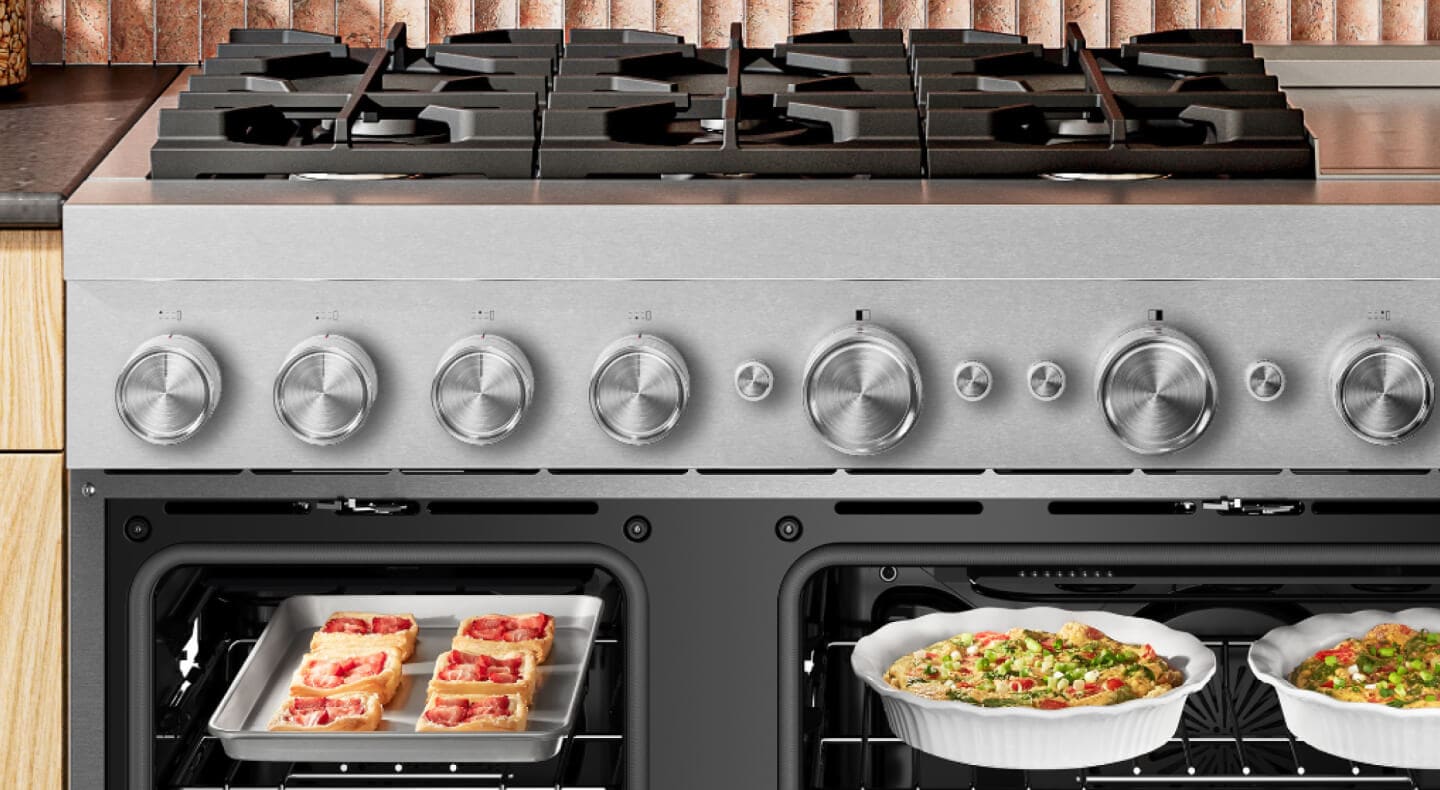
Double oven ranges have two ovens built into them. They offer the convenience of having two ovens in one place—well-suited for those who want to cook multiple dishes needing different settings at once or for large groups. The two ovens can be used together or separately, allowing you to cook larger meals on both, or heat up just one for smaller meals. Double oven ranges come in electric, gas and dual fuel varieties and select models provide features like convection cooking and self-cleaning options.
This configuration may be beneficial for households of five or more people or those who frequently host gatherings and prepare holiday meals. Investing in a double oven provides maximum cooking flexibility for complex menus, though it often requires a higher budget. In contrast, those with smaller households of one to four people who typically cook one dish at a time may find a single oven better suits a preference for simplicity and streamlined maintenance.
KitchenAid® Double Oven Ranges
Get the most out of your making
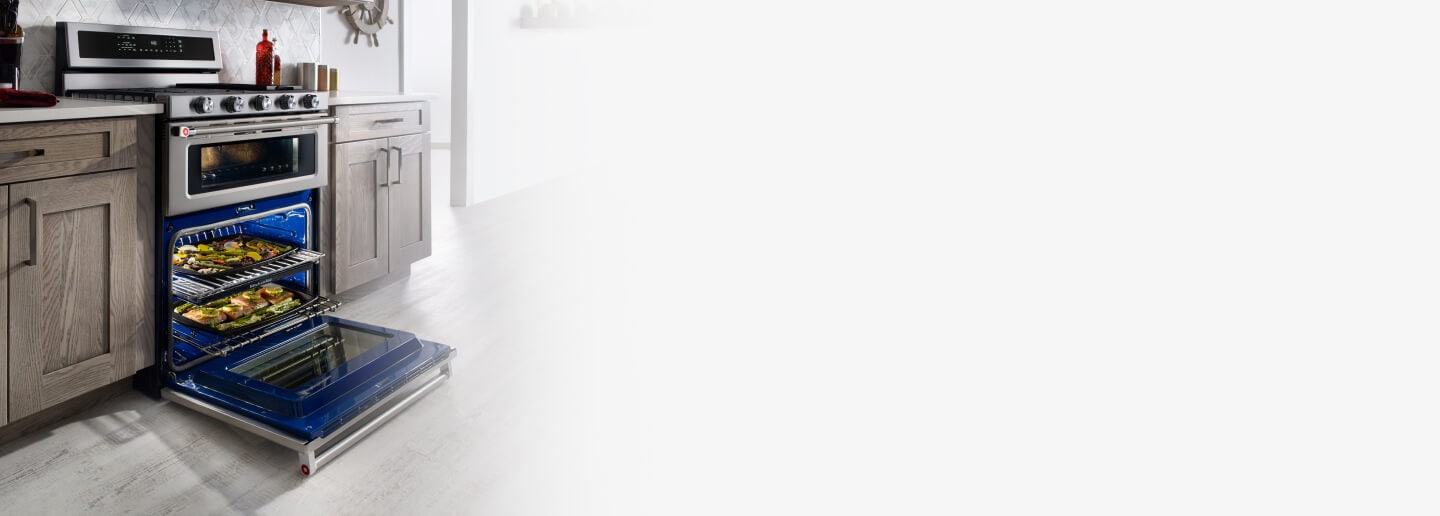
Whether you’re cooking multiple course meals or testing new recipes, KitchenAid® double oven ranges offer flexible cooking capacity to nurture your creativity
Shop KitchenAid® commercial-style ranges
Bring professional-grade performance into your home with a range designed for high-heat techniques and precision. Select KitchenAid® commercial-style ranges feature bold design elements like heavy-duty knobs and grates, paired with customizable finishes to match your unique culinary space. You can choose from a wide spectrum of bold colors on select models, including Agave, Wildflower, Scorched Orange, Cardamom, Juniper, Black Ore and classic Stainless Steel.
Beyond their striking appearance, these ranges are equipped with high-end features to expand your cooking capabilities. Select KitchenAid® models include a Chrome-Infused Electric Griddle, No Preheat Air Fry Mode and an Integrated Wok Grate.


Range fuel types
The primary fuel types for kitchen ranges are gas, electric, induction and dual fuel. Choosing a fuel type is often one of the first decisions to make during the buying process, as it is largely determined by the existing utility connections in your kitchen and your specific cooking preferences. Whether you prefer the responsiveness of a gas flame, the even heat of an electric element or the precision and speed of induction, evaluating your home’s infrastructure alongside your culinary style will help narrow your options. Learn more about each fuel type below.

1. Gas ranges
Gas ranges use natural gas or propane to heat burners and ovens. They often come with four to five burners on the top, which you can adjust to different temperatures depending on what you’re cooking. Some gas ranges may also include a broiler, allowing foods to be cooked directly under an open flame. Gas ranges often provide more responsive temperature control than radiant electric ranges and tend to heat quickly, making them a popular choice.
KitchenAid® gas ranges come in freestanding, slide-in, double oven and commercial styles and allow you the precision and control to go from sautéing to boiling and back again with the turn of a knob. Explore select models with 4 to 6 burners and features like Even-Heat™ True Convection and Steam Bake Mode with a Steam Bake Tray.
Fueling a gas range requires a dedicated natural gas or propane line, which can often be installed by a professional if one is not already present. This fuel source powers an open flame on the stovetop and in the oven, providing highly responsive burners that move between heat levels quickly. The ability to utilize both high and low heat levels gives you control over cooking temperatures, helping you melt, simmer and fry ingredients with ease.

2. Electric ranges
Electric ranges use electricity as their source of power for cooking. They often feature a smooth, glass cooktop with 4-5 burners that is easy to wipe clean. The oven features top and bottom electric heating elements, with some convection models available. A gas line is not necessary for an electric range, making installation easier if you’re not set up for gas. Learn more about the differences between gas vs. electric stoves.
KitchenAid® electric ranges come in freestanding, slide-in and double oven models. Select models feature 5 cooking elements, including a Warm Zone, so you can do more with your range.
These ranges offer several distinct advantages for the home cook, starting with effective heat transfer. Unlike gas stoves that can lose heat to the surrounding air, electric burners heat pots and pans directly to help retain heat while cooking. The dry heat produced by electric ovens is also excellent for achieving nicely browned results on everything from rustic bread to roast chicken.
The flat surface of a smooth-top electric cooktop allows for simple cleanup, as it can be wiped down without removing heavy grates. Additionally, these cooktops often provide versatile stovetop space; select KitchenAid® electric ranges feature multi-ring burners, such as a triple cooking zone of 6, 9 and 12 inches, which allows you to switch between elements based on the width of your cookware.
3. Dual fuel ranges
Dual fuel ranges combine the even baking and roasting of an electric oven with the responsive cooking control of a gas cooktop. These ranges typically feature four to five burners and come in freestanding, slide-in, commercial and double oven models.
Select KitchenAid® dual fuel ranges feature 5 burners, including 2 dual-stacked burners that deliver two levels of heat at once—allowing you to quickly go from a rapid boil to a low simmer. Even-Heat™ True Convection on select models provides optimal temperatures for crisp, flaky baked goods, juicy, well-browned roasts and caramelized vegetables.
Dual fuel ranges work by requiring a gas line hookup for the cooktop and an electric hookup for the oven. This configuration is designed to deliver responsive temperature control on the cooktop alongside consistent, dry heat in the oven. The stovetop utilizes gas to provide an open flame that is ideal for sautéing and searing, while also allowing for techniques like charring peppers or cooking fresh tortillas.
Meanwhile, the oven uses electric heating elements to create a dry heat environment. This is particularly beneficial for those who love to bake and roast, as it provides ideal conditions for browning and crisping results, such as golden brown roasted vegetables. By combining these two fuel sources, a dual fuel range provides the versatile heating options needed to explore a wide variety of recipes.

4. Induction ranges
An induction range is a stovetop that uses electromagnetic energy to interact with compatible pots and pans, turning the cookware itself into the heat source. This process occurs through a copper coil located under the ceramic glass that creates a magnetic field, heating the bottom of the pan quickly and precisely. Because the heat is created directly within the cookware rather than being transferred from a heating element through the cooktop surface, these ranges may help reduce heat loss. This technology is a distinct alternative to a dual fuel range or traditional electric models.
One of the most significant benefits of an induction range is its increased responsiveness, offering a rapid rise and fall in temperature that allows you to go from a boil to a simmer in a short amount of time. Since the surface of an induction cooktop does not generate its own heat, it stays relatively cool around the pan and cools down quickly once the cookware is removed. This cooler surface adds convenience in a busy kitchen and makes cleanup easier by helping to reduce baked-on or charred spills.
Select KitchenAid® induction ranges further enhance the experience with precision control features. For example, Temp Cook™ Smart Presets can set and hold ideal temperatures for popular methods and alert you when to add ingredients. Additionally, some models feature Sensor Induction Technology that generates heat directly within cookware, reaching high temperatures quickly and cooling down rapidly for precise control that enables a full range of cooking techniques.


Kitchen range FAQs
Choosing a new range often brings up technical questions regarding installation, ventilation and power requirements. The following frequently asked questions provide clarity on the logistical side of upgrading your appliance to help ensure a smooth transition into your kitchen.
Can you install a range yourself?
You can install a range with the help of a friend if you are familiar with the process. Always read your installation instructions and consult with a professional if needed before installation. To install a gas or electric range, you should first consider factors such as measurements, kitchen layout and gas or electrical requirements that can help ensure a seamless installation. It is recommended to consult a professional for a gas line installation. To learn more about range installation, read this guide.
Do all kitchen ranges need a range hood?
A range hood will help vent smoke, odor and grease out of your kitchen, or filter it while you cook. Proper ventilation makes the kitchen more inviting so you can fry, sear or sauté without distraction. Ventilation is also key for cleanliness around your range or cooktop. There are many different types of range hoods to choose from, depending on the style you like, your kitchen’s layout and the ductwork. Check your local building codes to determine if a range hood is required by law.
Can I switch from a gas range to an electric range?
You can transition from a gas to an electric range if your home meets electrical supply requirements. This process requires a certified professional to turn off and cap the gas line and potentially a contractor to run a new electrical line and install the necessary outlet.
Because electric ranges require a higher voltage than the standard outlets used by gas models for ignition, you’ll need to make sure your kitchen's electrical supply is sufficient. Consider consulting with a certified professional to ensure the new electrical line and outlet installation meet all safety standards and requirements for your home and appliance.
Learn More About Smart Ovens
Need Help Finding Your Next Range?
Shop KitchenAid® ranges
Baking, broiling, sautéing and simmering—your kitchen range helps you do it all. If you're looking for a new stove, explore the KitchenAid brand line of gas, electric and dual fuel options. Among the available options are convection ranges for even baking and roasting across multiple racks, commercial-style ranges for a professional look and feel, and slide-in ranges for a seamless integration.

KitchenAid® Hardware Accessory Kits
Curate the colors and textures that move you
From bold Black Ore to the inviting warmth of Bronze, mix and match handles and knobs to refresh your appliances and bring new energy to your kitchen


Your subscription was successful
Thank you for signing up. Keep an eye on your inbox for our next newsletter.
Stay Connected – Join the List
Enjoy articles like this? Get helpful guides and appliance care tips sent straight to your inbox.

